Energy Market Overview: February’s Record Consumption Kept Electricity Prices Elevated
As February draws to a close, Estonia can finally begin to leave behind the long, cold and dark season. A more spring-like outlook is also starting to appear in the energy markets as March approaches. February itself, however, remained distinctly wintry in Estonia and was marked by exceptionally high electricity consumption.
According to the Estonian Environment Agency, February 2026 was—similarly to January—one of the coldest in recent years, with an average air temperature of –8°C. The last time February was colder was in 2012, when the average temperature reached –8.7°C.
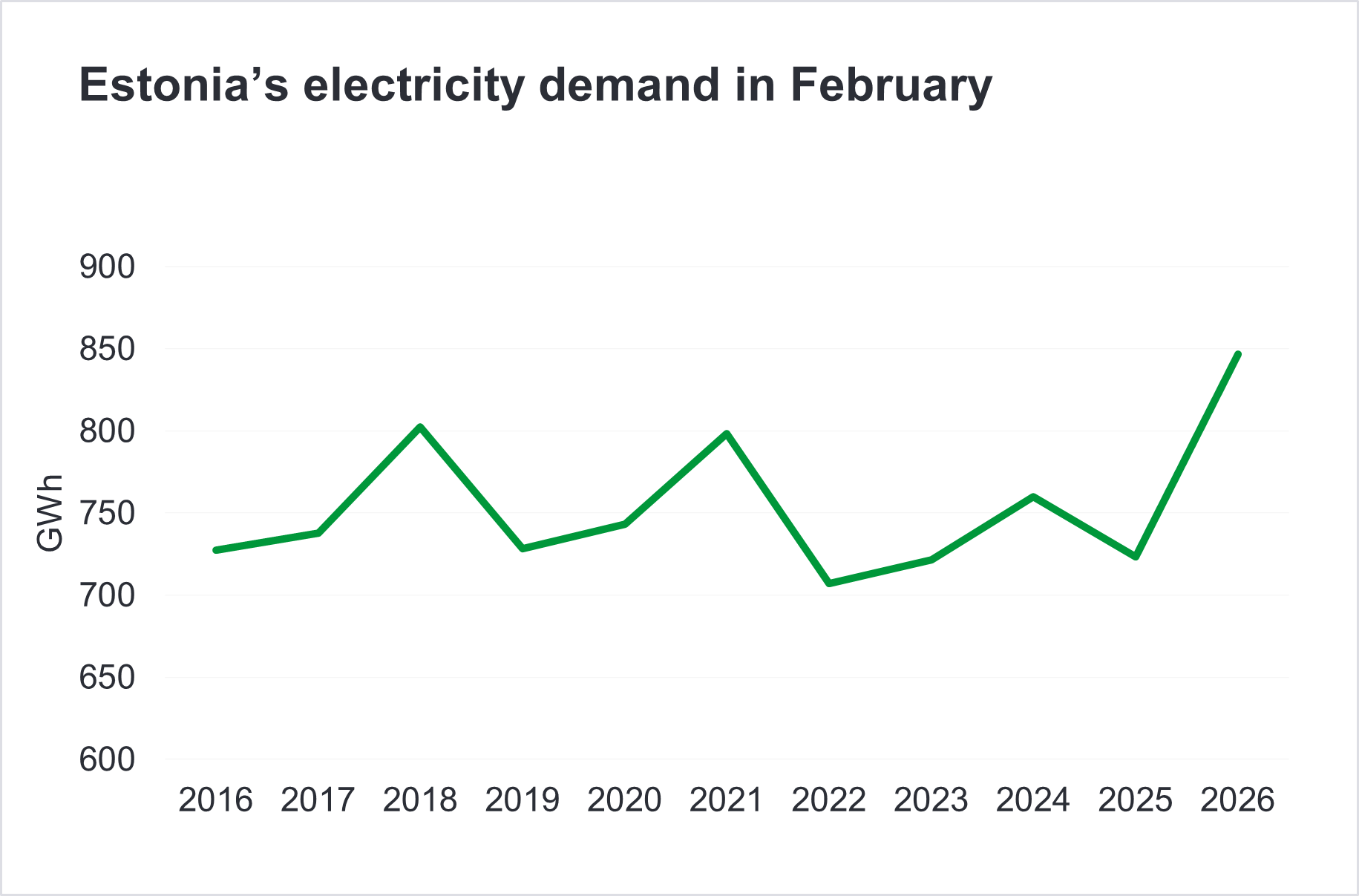
The biting cold significantly increased electricity consumption and prices. Such high electricity demand has never before been recorded in Estonia during February. High consumption goes hand in hand with higher prices, especially when there is a shortage of low-cost domestic electricity production. The average electricity price for February was 15.5 cents per kilowatt-hour, almost identical to January (15.4 c/kWh) and last February (15.2 c/kWh).
What Drove Prices in February?
As noted above, electricity consumption in Estonia was exceptionally high in February, driven by increased heating needs due to cold weather and the continued electrification of the economy. Compared with the average February electricity consumption over the last decade, this year’s figure was 14% higher (745 GWh vs 847 GWh). Compared with February 2025, consumption increased by 17%.
At a time when demand is growing, the Baltic region continues to lack modern, consumer-friendly and competitively priced electricity production. In practice, this means that Estonia and its Baltic neighbours must rely more heavily on inefficient fossil-based generation—around 35% of Estonia’s electricity consumption in February was covered by domestic fossil-fuel production.
At the same time, electricity prices were elevated across Europe, limiting the ability of imports to ease price pressures. Imports usually help pull prices down when Estonia’s main partners—Finland (via Estlink) and Sweden (via Lithuania)—have ample low-cost electricity available, primarily from wind and hydro generation, supplemented by affordable nuclear output. In February, however, demand remained uniformly high across the entire Baltic Sea region, leaving neighbouring markets with too little cheap electricity to ease Estonia’s price levels. Imports covered 43% of Estonia’s consumption in February, yet the imported electricity mix was also dominated by fossil-based production. This reliance on fossil fuel generation came at a particularly unfavourable time, as CO₂ quota prices remained high, further increasing the cost of fossil-based electricity.
Compared with last February, wind generation across the Baltic region was nearly 89% higher this year. This was primarily due to the normalisation of wind conditions (last February was exceptionally windless) and the addition of new generating capacity. Wind power covered around one-fifth of Baltic consumption in February, pushing more expensive power plants out of the market during windy hours. Without wind energy, electricity prices in February would have been even higher. However, the region still lacks sufficient wind capacity to meet high consumption levels even during windy periods.
What to Expect in March?
Signs of spring are also becoming visible in the Baltic energy markets. Electricity markets are highly seasonal, and the arrival of milder weather and longer days strongly influences renewable generation both in Estonia and the wider region.
While wind generation remains variable throughout the year, solar generation becomes significantly more predictable beginning in March as daylight increases. Therefore, solar output in March is expected to be higher than in January and February. This should help reduce daytime prices, as low-cost solar electricity flows into the grid not only in the Baltics but also across Europe, improving the overall supply mix during midday.
The retreat of cold weather will reduce heating demand across Europe. This in turn eases pressure on fossil-fuel generation and increases the share of renewable energy in the consumption mix of the average Estonian customer.
Hydropower output remained low during the winter because of prolonged cold, but spring and melting snow typically bring a period of high water levels. This increases hydropower production both in the Nordics and Latvia, helping to put downward pressure on electricity prices. Price formation will also continue to depend on wind conditions in the Baltics and Nordics, as well as on how much low-cost renewable electricity can reach the Baltic markets through cross-border transmission capacity.
Geopolitics will remain an important factor, especially through gas markets. If tensions in the Middle East—particularly around the Strait of Hormuz—persist or escalate, gas prices could rise rapidly. Early March has already brought an increase, and this trend could continue if tensions remain high. Higher gas prices feed directly into European electricity prices, as gas-fired generation becomes more expensive. Importantly, rising gas prices affect even those countries that use relatively little gas directly: gas becomes a price-setting fuel in regional markets, lifting benchmark electricity prices and transmitting these effects onward through interconnections to the Baltic region.
Karl Joosep Randveer, Analyst, Enefit Energy Trading
This market overview has been prepared by Enefit to the best of its current knowledge and is based on publicly available information. The overview is provided for informational purposes only and does not constitute a promise, offer or official forecast by Enefit. Due to rapid changes in electricity market regulations, the information herein is not final and may not reflect future developments. Enefit bears no responsibility for any costs or losses that may arise from the use of this information.